
Portable washing machines work like small top-loaders: they fill from a sink faucet or by hand, move clothes through the water with a spinning plate at the bottom of the tub, then drain and spin the water out. A fully automatic model runs every step itself. A twin tub washes in one tub and spins in a second, and you move the clothes and set each timer.
Manual washers skip the motor. The Laundry Alternative says its WonderWash uses a hand crank and water pressure and needs no electricity or plumbing. None of these types dries clothes with heat; only washer-dryer combos do. All of them still need water in, a place for water to go out, and, for electric models, a grounded outlet.
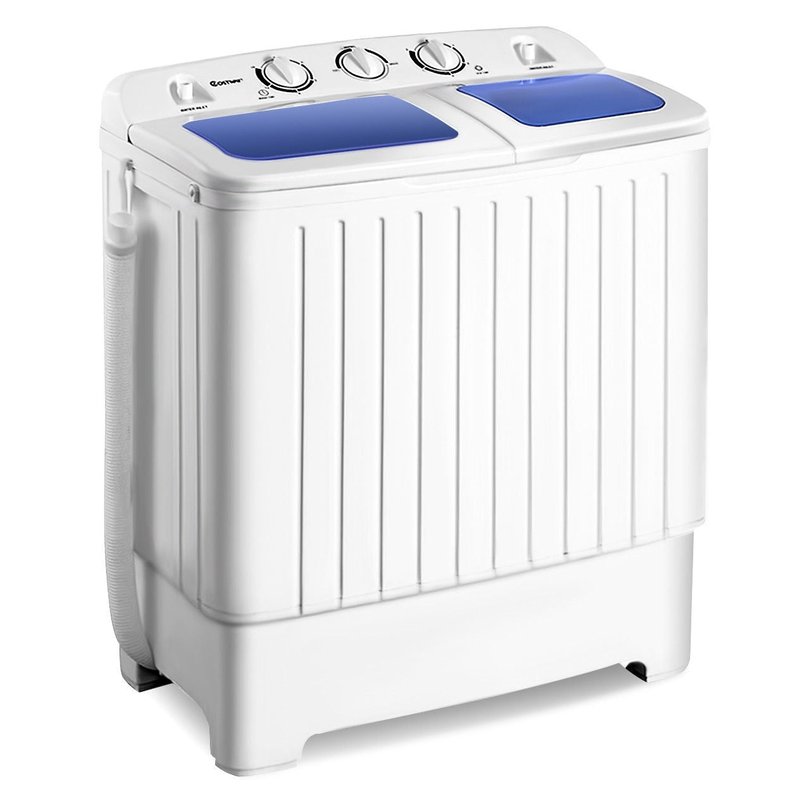
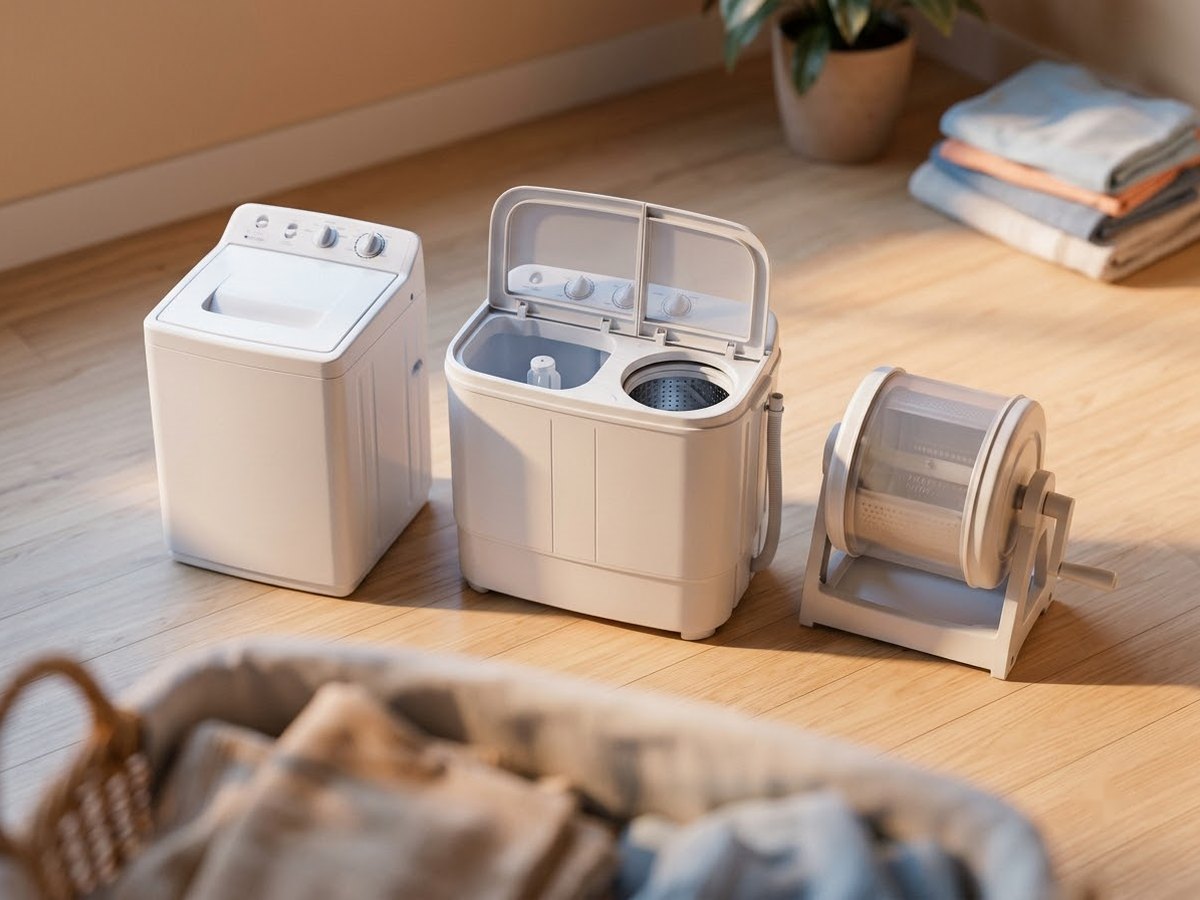
The three main types at a glance
| Type | How it washes | How water leaves | Your job |
|---|---|---|---|
| Fully automatic | Motor-driven plate in one tub; the machine sets fill, wash, rinse and spin | Drain hose to a sink or standpipe | Load it, pick a program |
| Twin tub (semi-automatic) | Wash tub and separate spin tub, each with its own motor and timer | Drain hose, often gravity only | Fill, set timers, move clothes, drain |
| Manual | Hand crank, foot pedal or rubbing in a bag | Drain spout or open the bag | All of it, by hand or foot |
NBC Select sums up what the electric types share: portable machines “still offer the essential wash, rinse and spin cycles.” It adds that “Some models offer dual tubs for separate washing and spinning.” If you’re still deciding whether to buy one at all, start with whether portable washers are worth it.
How a fully automatic portable washer works
A fully automatic portable runs one program from start to finish. You load dry clothes, add detergent, pick a cycle and press start. The machine fills, washes, drains, rinses and spins, then stops.
- Fill. Water comes in through an inlet hose, usually from a kitchen or bathroom faucet with a quick-connect adapter. NBC Select says most portable washers come with one.
- Wash. A plate at the bottom of the tub rotates and moves the clothes through the water. BLACK+DECKER’s manual calls its 0.9 cu ft model a high efficiency washer and says “The water will not normally cover the clothes.”
- Drain and rinse. The washer empties through its drain hose and refills for each rinse.
- Spin. The tub spins fast to push water out of the clothes. The clothes come out damp, not dry.
You can often control each step. BLACK+DECKER’s manual says you can choose any mix of wash (1–20 minutes or none), rinse (1–3 times or none) and spin (3–9 minutes or none), or pick a preset: Heavy, Gentle, Normal, Rapid or Soak.
Some sense the load for you. GE’s GNW128P manual says automatic load sensing sets the agitate profile, the agitate time and the water amount, and that a lower water level than your old washer is normal. Others rebalance lopsided loads mid-cycle: Magic Chef says that if laundry bunches on one side during spin, its washer adds water to even it out, and after three tries you must redistribute the clothes by hand.
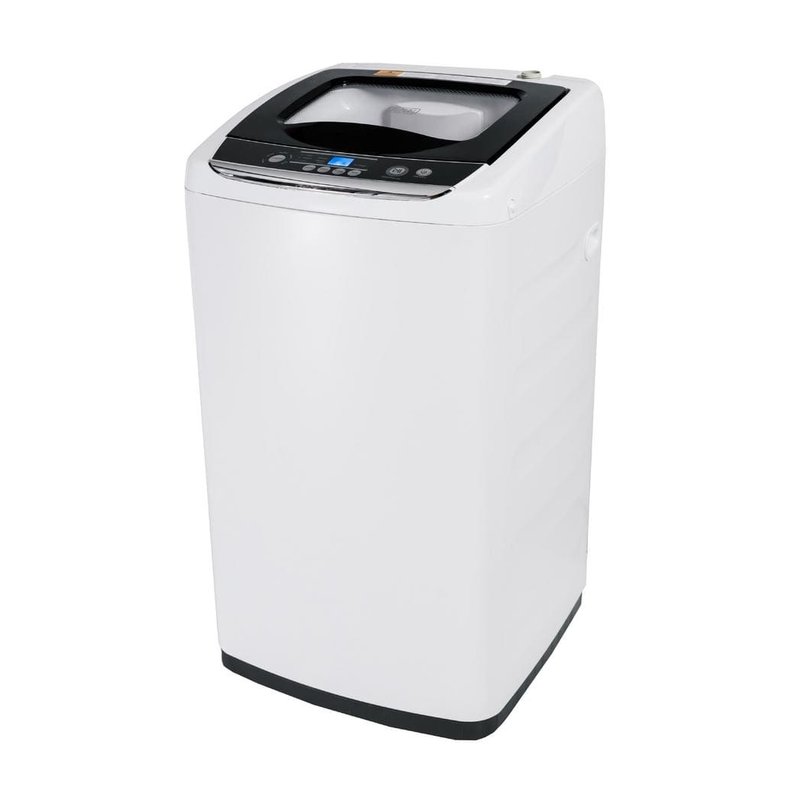
Smallest fully automatic · Mid-range price range
BLACK+DECKER 0.9 cu ft Portable Washer
HGTV named it its best overall portable washer. BLACK+DECKER rates it at 0.9 cu ft and 6.6 lb, with five presets plus custom wash, rinse and spin times, for cold water only.
See colors & options ›How a twin tub works
A twin tub has two tubs side by side. The PUCWM22 twin-tub manual says it has two motors, one for washing and one for spin drying, so you can wash one load and spin another at the same time. The wash tub has a pulsator, a spinning disc at the bottom that moves the clothes.
That manual describes each step:
- Wash. Put clothes and detergent in the wash tub, set the selector to “Wash,” fill with water to the level in the Laundry Guide, and set the wash timer.
- Drain. When the timer ends, set the selector to “Drain” to empty the tub.
- Rinse. Set the selector back to “Wash,” turn the tap on, turn it off when the rinse water runs clear, then drain again.
- Spin. Move the clothes to the spin tub, small items first, spread them evenly, put the spin mat on top and set the spin timer. Wait until the spin tub stops completely before you reach in.
The cycles are short. The PUCWM22 Laundry Guide lists 5–10 minutes of washing and 3–5 minutes of spinning for colored cotton and linens, and 2–3 minutes of washing for delicates. All of its wash temperatures are “Below 104°F.”
The spin tub is usually smaller than the wash tub. The PUCWM22 is rated at 3.5 kg for washing but 1.5 kg for spinning, so a full wash load may need two spins. Many twin tubs, like the Giantex, also drain by gravity, so the drain must be lower than the machine. For more on this type, see our twin tub washers with spin dryers.
How manual washers work
Manual washers trade effort for independence from outlets and faucets.
- Hand-crank drum. The Laundry Alternative says its WonderWash “cleans a small load in just 1–2 minutes using water pressure and a simple hand crank,” holds 5 pounds of dry clothes and uses about 2 gallons of water per load. There is no spin, so clothes come out wet.
- Spin dryer add-on. The Laundry Alternative’s Ninja spin dryer has no heat. The brand says it spins at 3200 RPM, plugs into a 110V outlet and removes “up to 90% of moisture in 3 minutes.”
- Foot-pedal washer. HGTV named the Yirego Drumi its best manual washer. Yirego says it handles up to about 4.4 lb.
- Wash bag. Scrubba says its 5.3-ounce bag washes up to 2 T-shirts, 2 pairs of socks and 2 pairs of underwear per load. You add water and detergent, seal it and rub the clothes against the ridges inside.
We found no manufacturer or testing source that measures how well foot-pedal washers or wash bags clean, so we can’t rank them against electric machines.
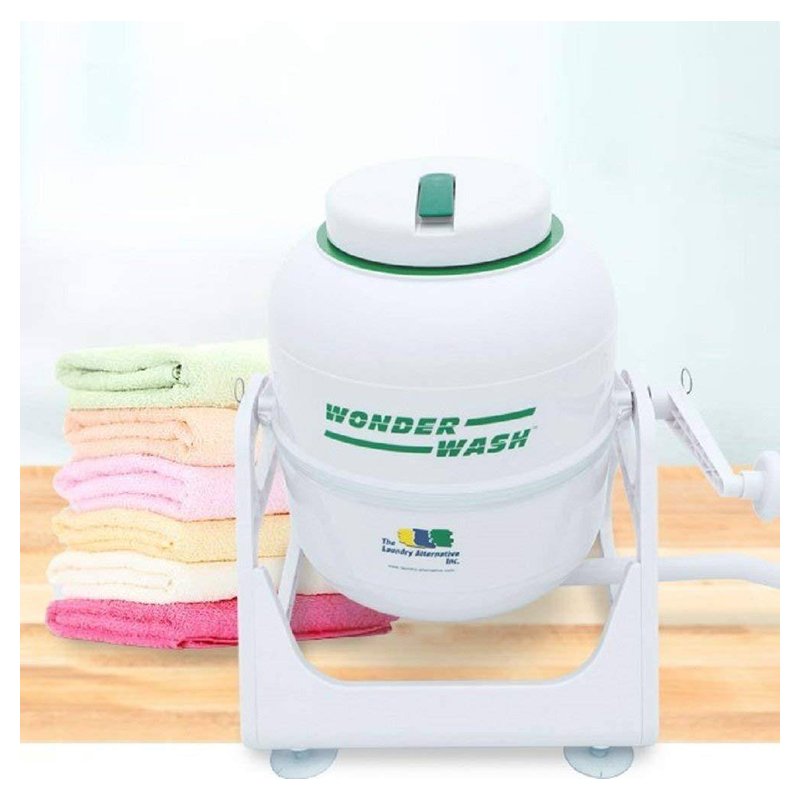
No power, no plumbing · Budget price range
The Laundry Alternative WonderWash
HGTV named it its best budget manual washer. The Laundry Alternative lists it at 5.7 lb and 5 lb of dry clothes per load, with a 3-year warranty.
See today’s price ›What every type still needs
No portable washer is hookup-free in the full sense. Each needs a way to get water in and out:
- Water in. A faucet that accepts the adapter, or a bucket. Consumer Reports says it couldn’t find a sink faucet that fit all five portable models it tested.
- Water out. BLACK+DECKER’s 0.9 cu ft manual says its drain hose can go over a wash basin edge, into a standpipe or into a laundry tub 32–39 inches high. The PUCWM22 twin-tub manual says the hose must let water “drain down without any obstruction.”
- Power, for electric models. BLACK+DECKER says to plug its washer straight into a 120V socket rated 15 amps or higher, used for the washer only, and warns that an extension cord or power strip may cause electric shock or fire.
Temperature limits matter too. The PUCWM22 manual says wash water should stay below 120°F so plastic parts don’t deform. Giantex gives 129°F as the limit for its twin tub.
Honest note
Portable washers don’t dry clothes, and twin tubs need you nearby. The spin removes much of the water, but clothes still need to air-dry or go in a dryer. NBC Select also warns that the Giantex twin tub doesn’t stop filling on its own, so you have to watch it fill. A twin tub’s smaller spin tub can mean spinning one wash load in two batches.
Questions people ask
Do portable washers have an agitator?
The manuals we read describe a pulsator, a spinning disc at the bottom of the tub. The PUCWM22 twin-tub manual lists one as part of its wash tub, and BLACK+DECKER’s 0.9 cu ft manual refers to its pulsator when explaining how to level the washer. We found no source that compares how agitators and pulsators clean or wear clothes.
Does a portable washer heat its own water?
Most don’t. BLACK+DECKER says its 0.9 cu ft model runs on cold water only. Its 2.0 cu ft model has a hot inlet that uses your tap’s hot water but no internal heater. Of the machines we cover, the Equator washer-dryer combo is one that lists a built-in water heater.
Why is there so little water in the tub?
High efficiency washers use less water by design. BLACK+DECKER’s manual says the water will not normally cover the clothes. GE’s GNW128P manual says the level may be lower than on your previous washer and that this is normal.
Do twin tubs dry clothes?
No. A twin tub’s second tub spin-dries clothes, which spins water out, but there is no heat. The spin removes much of the water, so clothes still need to air-dry or go in a dryer afterward.
How long does a wash take in a portable washer?
It depends on the type. The PUCWM22 twin-tub guide lists 5–10 minutes of washing for cottons. BLACK+DECKER’s automatic lets you set 1–20 minutes of washing, plus rinses and a 3–9 minute spin. The Laundry Alternative says the WonderWash takes 1–2 minutes of cranking.
Sources: NBC Select: Best portable washing machines · BLACK+DECKER BPWM09W manual (Home Depot) · PUCWM22 twin tub manual (Lowe’s) · GE GNW128P owner’s manual · The Laundry Alternative: WonderWash and Ninja · Scrubba wash bag
This article is general information. Specs and capacities are the brands’ own. Follow your washer’s manual for electrical, water and drain setup, and check your lease or campground rules before you install one.